Why We Give: Louis Del Re
June 15, 2026
9 min read


After his ALS diagnosis, Louis Del Re found purpose in bringing people together to act towards one shared goal: “to end ALS.”
When Louis Del Re talks about ALS, he talks about movement.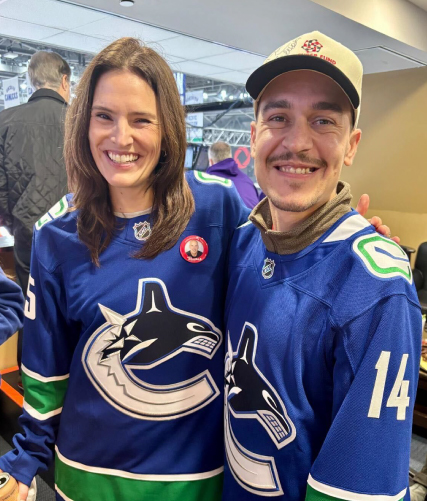
Not physical movement, though that has been a central part of his life for as long as he can remember. He means momentum and energy. Showing up for one another. Refusing to sit still in the face of something difficult.
The phrase he returns to most often is “Keep on Buzzin.”
For people in the hockey world, “buzzing” means a team playing with pace and intensity. For Louis, the phrase has grown into something much bigger. It became a mindset long before his ALS diagnosis, and now it carries him through life with the disease.
“It’s a reminder for resilience and to never give up,” he says. “To always find gratitude, and to show courage.”
Louis, who goes by Lou, is 33 years old and lives in Stouffville, Ontario, with his wife Emily and their dog Auston. He grew up in Pickering alongside his two younger brothers in a family centred around sports, especially hockey.
He describes himself as a late bloomer on the ice. Smaller than many of the other players, he learned to rely on speed, work ethic, leadership, and persistence. Hockey shaped much of how he saw himself. It also shaped the way he approached hardship later in life.
In late 2022, Louis began noticing subtle changes in his voice. Soon after came muscle weakness and difficulty swallowing. In June 2023, at age 30, he was diagnosed with ALS, also known as Lou Gehrig’s Disease.
“Facing your mortality at 30 is incomprehensible,” he says. “It took me to some of the darkest places I’ve ever known.”
Finding purpose again
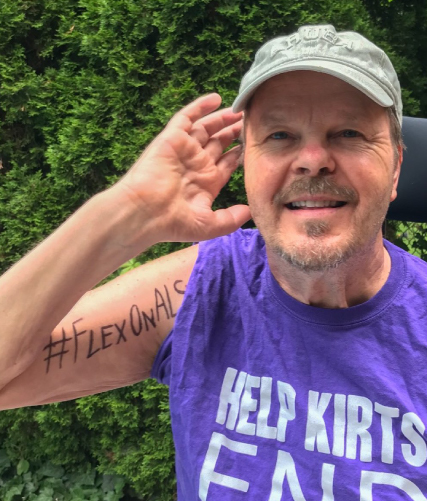 Before his diagnosis, Louis did not see himself as someone deeply involved in charitable giving or advocacy work. Like many Canadians, he cared about the people around him and the issues affecting them, but charitable giving was not a major part of his day-to-day life.
That changed after he met Mark Kirton, the founder of the ALS Super Fund, a Cause Fund powered by Charitable Impact, and a former NHL player who lived with ALS until his passing in 2025.
“As you can imagine, when you get diagnosed with ALS, you can go to a pretty dark place,” Louis says. “And I was there. I was in a very bad place for a while. And then I met Mark.”
Their first conversation shifted something.
“The first call I had with him, I’m doing my best to hold my tears in, and all he could do was make jokes and put a smile on my face,” Louis recalled. “He showed me that there is light and he showed me how I can find my purpose again.”
That purpose quickly turned outward.
Louis joined ALS community support calls, attended advocacy events, and began speaking publicly about the disease. He travelled to Parliament Hill twice to help ensure the voices of people living with ALS were heard. He joined the Board of ALS Action Canada and became active on both the Advocacy Committee and Fundraising Committee. He also became deeply involved in the Courage to Fight campaign, a growing movement connected to the ALS Super Fund.
What surprised him most was how many people wanted to help once they were invited in.
“I realized that my power is connecting and sharing my story with other people that I meet,” he said.
Turning care into action
Louis began using Charitable Impact as a practical way to organize that support.
He opened an Impact Account in late 2024 and started building Giving Groups, which are online communities raising funds towards a shared cause — in this case, for the ALS Super Fund.
One Giving Group, called Keep on Buzzin’, became a place where friends, family, coworkers, and supporters could contribute collectively toward ALS research and support efforts.
Another Giving Group supported Ales for ALS, a brewery initiative Louis helped introduce to Canada, where participating breweries donate a portion of beer sales toward ALS research.
For Louis, connecting the Giving Groups to the ALS Super Fund solved a challenge many donors face. He knew he wanted to mobilize support for ALS, but he didn’t feel equipped to personally decide which organizations were best positioned to receive every dollar. The Cause Fund allowed him to focus on rallying his community while trusted ALS experts made the final decisions about how to best allocate the raised money to find a cure.
Together, the groups have already raised tens of thousands of dollars. But for Louis, the experience has never been only about the numbers. The Giving Groups became a way for people to participate while learning about ALS and the impact it has on patients and their loved ones.
Some people donated and some shared the campaign with friends. Some organized events or conversations in their own communities. Others simply showed up.
“That sense of community is more than a feeling,” says Kevin Moorhead, Senior Director of Cause Funds at Charitable Impact. “It’s the basis of action.”
Louis saw that happen for him firsthand.
His community now includes childhood hockey friends, family members, coworkers, researchers, NHL organizations, and people across the ALS world. Through the ALS Super Fund and related advocacy efforts, he has built relationships with organizations across Canada and the United States, including Sunnybrook Hospital, the ALS Society of BC, the Montreal Neurological Institute, ALS TDI in Boston, Augie’s Quest in Denver, the Peter Frates Foundation and Bourque Family Foundation in Boston, Tackle ALS in New York, and Team Goose in New Jersey.
His approach to collaboration is simple.
“We have one goal: to end ALS,” Louis says. “We don’t care about borders, we don’t care what organization you’re from, and we don’t care about politics. If you share our goal, we will collaborate.”
Redefining courage
As ALS progressed, Louis also found himself redefining what courage meant.

Growing up in hockey culture, courage once meant physical sacrifice, like standing up for your teammates, playing through pain, or blocking a shot. Now, he approaches courage a bit differently.
“When life gets difficult, for example getting diagnosed with ALS, how are you going to respond? How are you going to keep showing up for the people you love and how are you going to continue to live a meaningful life?” he asks.
Those questions have shaped how he approaches advocacy and giving.
Rather than waiting until he had all the answers, Louis started by taking action. He shared his story and invited people in. He created ways for others to participate alongside him.
In many ways, that is what giving became for him: a way to move forward when life felt uncertain.
It also changed how he thinks about community.
“People gravitate towards that bigger vision,” ALS Action Canada Executive Director Leigh Naturkach says about Louis. “That collective, by setting that example, that’s something that draws people in.”
Living with intention
Louis continues to face the realities of ALS every day. He is currently participating in a groundbreaking clinical trial at Sunnybrook Hospital involving MRI-guided focused ultrasound technology, becoming one of only six participants involved in the research.
At the same time, he continues to advocate, organize, connect people, and build community around the cause.
He also continues to think deeply about what it means to live well while facing something unimaginably difficult.

“When a couple says ‘in sickness and in health,’ most people assume the sickness is far in the future,” Louis wrote about his wife Emily. “She made the ultimate sacrifice for our love. Teaching me the true meaning of devotion, love and marriage.”
Giving, for Louis, is connected to all of it: love, connection, purpose, and participation.
He knows many people want to help but do not always know where to start.
Sometimes the challenge isn’t caring enough. It’s knowing where to direct that care. For Louis, the ALS Super Fund removed that uncertainty. Rather than spending time trying to determine which organization to support, he could focus on inviting others into the cause, knowing that experienced leaders were helping guide the broader strategy.
His story suggests that the first step does not need to be perfect or complicated. Sometimes it begins with sharing your story, inviting others in, or creating one practical way for people to act on what they already care about.
“I think that regardless of what life throws at you,” Louis said, “there is always a way forward. You just have to see it.”