Why We Give: Janet Fanaki
March 23, 2026
11 min read

In the wake of profound loss, Janet Fanaki built a community of giving to honour the lives of her husband and daughter.
Janet Fanaki will be the first to tell you she is not extraordinary. She has no background in fundraising, but what she does have is a deep love for her family and a willingness to act when life becomes unbearably hard.
Over the past six years, Janet has endured the deaths of her husband, her parents, and most recently, her daughter Isobel. Each loss has called her toward something she never expected: building community and resilience through giving.
The life they built together

Janet met Adam at a Friday night dinner with friends. She didn’t know it at the time, but their meeting had been arranged as a set-up. They clicked immediately.
“I asked him what his sign was, and he said Sagittarius. I said, so am I,” Janet laughs. “Then he told me his birthday. December 6. Same as mine. Same year, too.”
They built a life together in Toronto. Twenty-four happy years of work, partnership, travel and raising their two children: a daughter, Isobel, and a son, Samuel.
In 2016, Adam began experiencing unusual health symptoms—memory and hearing loss. He pushed his doctors for extra testing. Janet clearly remembers the moment she found out his diagnosis. She was driving to meet him at the hospital, only a day before they were to fly to New York for the US Open.
“He said, ‘It’s a brain tumour. And it’s terminal.’”
For three and a half years, they courageously fought against glioblastoma, an aggressive form of brain cancer. Adam passed away on February 15, 2020, at the age of 51.
Giving becomes a way forward
“I felt like there were two ways that the kids and I could go at that point,” Janet says. “We were either going to pursue something that’s positive that’s going to give us purpose and strengthen us or we’re going to just focus on everything we’ve lost.”
She knew that they would always feel a void with Adam’s absence, but they could also do something positive in his memory.
She thought of her childhood and stories about her relatives being involved in grand initiatives within the Ukrainian community. They helped fundraise to build new churches and institutions in Canada.
Janet had been taught that when life becomes overwhelming, you channel your energy elsewhere. That helps you move forward and grow. She decided to apply that lesson when it came time to write Adam’s obituary.
“Often, when people write obituaries, they include a line about a charity or organization to support,” Janet says. Unsure how to do that in a way that felt right, she reached out to a friend who had recently lost his wife to breast cancer. “I told him, ‘I’m thinking about doing some kind of crowdfunding. What did you do?’”
He introduced her to Charitable Impact’s Giving Groups, a place where friends, family, and community members can come together and pool donations. The donors receive immediate tax receipts, and the group’s organizer can decide, at any point, which charities receive the funds raised and when.
What mattered most to Janet was that nothing had to be decided right away, other than getting the page set up and shared with people that knew and loved Adam. The Giving Group could be created in Adam’s name, focused entirely on honouring him, without the pressure of having to immediately choose a charity. In the earliest days of grief, that mattered a lot.
And so The Adam Fanaki Brain Fund was created. For Janet, and for those who loved Adam, it became a way to honour his legacy first, and figure out the rest later.
When people showed up
 Janet had never fundraised before. She set up the Giving Group without expectations, trusting that if people wanted to do something in Adam’s memory, the structure would be in place. In addition to including the link to the group at the end of Adam’s obituary, she had also shared it with friends and family in an email as well as on social media.
The family watched as donations started rolling in right away. One organization gave $10,000, and another $25,000. Many of the donors were their friends, family, and neighbours, as well as Adam’s former colleagues and employers.
Although Janet didn’t realize it at the time, she had given Adam’s community a meaningful gift of her own: a way to work through their own grief and express their love and appreciation for him, while beginning to honour his legacy.
Adam was internationally recognized as one of Canada’s best competition lawyers and highly respected by his clients and peers alike. In fact, the Canadian Competition Law Moot was officially renamed in 2020 to the Adam F. Fanaki Competition Law Moot, now colloquially known as the Fanaki Moot—a testament to the wide-reaching impact Adam had on the competition law community.
“We decided to give to Sunnybrook and St. Mike’s,” Janet explains, referring to two hospitals in Toronto where Adam received care. “We also gave to the Brain Tumour Foundation of Canada and Sick Kids, corresponding directly with all of these organizations to ask where the money would be going. We wanted to make sure it was supporting patients and caregivers directly. Our fund has been covering the cost of medicine, parking, virtual support, printing and distribution of caregiver handbooks, sibling support and more.”
And all of this was happening while the world was living in a global pandemic. Having the fund to focus on became a form of distraction, therapy, and a reason for people to come together at a time of social distancing.
Losing Isobel

Four years after Adam’s death, Janet and her children were learning how to live alongside grief. In 2023, Janet’s father passed away and a year later, her mother as well. She had not imagined she would be asked to carry so much grief again so soon.
In November 2024, her daughter Isobel died suddenly of heart failure. She was 25.
“Isobel was an incredible young woman. As a child, she was very artistic. Quiet and academic at times. But also musical and bubbly, and an incredibly hard worker,” Janet reminisces. “She studied biology at university and became someone who was very conscious of nature and the environment.”
Isobel worked at Ripley’s Aquarium in Toronto for a time, and then at the High Park Nature Center. Coming from a well-travelled family, Isobel also spent her adult years travelling, finding herself on Canada’s east coast or overseas in the UK, Spain, and Asia.
Isobel was teaching English in Japan when she died. Janet and her son Sam travelled there and were met with an unexpected community already grieving alongside them.
“A funeral was held for her colleagues and students to attend,” Janet says. “It was overwhelming to see the connections she built in such a short time. Very young students, fellow teachers and school board officials all came to pay their respects and share their feelings with us.”
Honouring a life in full
When they returned home to Canada, Janet faced what she calls a surreal exercise: writing Isobel’s obituary. Once again, she arrived at the same question she faced while writing Adam’s. What should she say at the end? What could mourners support that could reflect who Isobel was?
“Unlike with Adam, this fund wasn’t going to be about medical treatments or the cause of her death,” Janet says. “We kept asking ourselves, what would Isobel want?”
Janet created a second giving group called The Isobel Fanaki Memorial Fund and mentioned it in her daughter’s obituary. In just over a year, over $40,000 was donated to the fund. From the beginning, she knew the focus would be on two causes that mattered deeply to Isobel: food banks—a cause that she had personally supported—and nature conservancy.
Janet directed gifts from Isobel’s fund to the High Park Nature Centre, a place that had been woven into her daughter’s everyday life. She also supported several food banks, including Daily Bread Food Bank, Food Banks Canada, and, most recently, the Bloor West Food Bank.
“I kept noticing these long lineups outside St. Pius Church on Bloor,” Janet says. “I didn’t know what was happening at first. Then I realized they were running a food bank, so I sent them a gift from Isobel’s fund. We continue to support them to this day.”
The Giving Group allowed Janet, her family, and their community to give directly to a place solely in honour of Isobel. Because a Giving Group was created, the donations didn’t need to be immediately directed to a charity, and the funds could be given thoughtfully, over time, as needs revealed themselves.
In many ways, that flexibility felt truer to who Isobel was. Her life was not defined by one passion or one concern, but by a constellation of interests, curiosities, and acts of care. Being able to support different organizations as needs emerged allowed Janet to honour that complexity rather than simplify it.
“Every time I give from what we’ve collected,” Janet says, “I think she’d be really pleased. I think she’d say, ‘Good job, Mom.’”
The power of community
While Adam was undergoing cancer treatment, Janet started the RESILIENT PEOPLE podcast.
“Even though what was going on with Adam was all-consuming, I needed something to busy my brain in a positive way,” she explains. “So I decided to interview regular people who had gone through a major life challenge and find a purpose from it. Selfishly, I was trying to build my own little positive circle of really resilient people because I felt like that would help me build my own resilience.”
What she ended up learning about resilience is that a lot of it comes down to the people you surround yourself with. One common theme Janet has found amongst all of her podcast guests is that they are intentional about building a positive community around themselves.
“We’ve built some really beautiful relationships through this fundraising. Not even necessarily with monetary donations, but with people that are just there cheering you on and supporting you because not everyone is in a position where they can give,” Janet says. “I look at the people that showed up through Adam’s and Isobel’s funds, and it feels good to have them around us.”
Moving forward
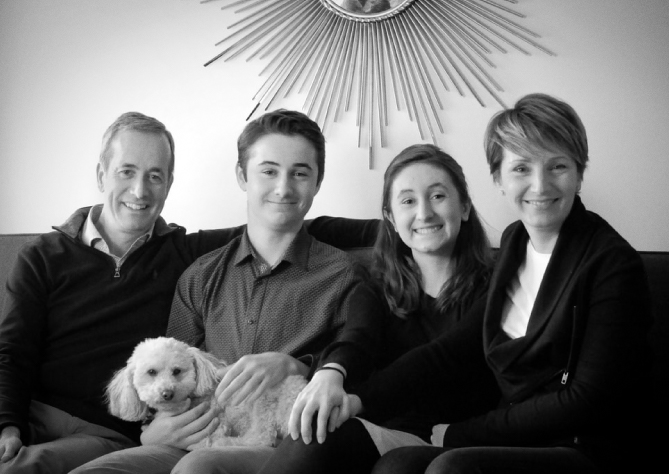 Janet continues working on RESILIENT PEOPLE, which now in season 5 focuses on those going through grief. She also plans to continue fundraising, and for Adam and Isobel’s impact to live on.
For Janet, giving doesn’t take the grief away. But it gives it somewhere to go.
“Grief can unravel you,” she says. “It will take everything from you if you let it. But as long as I’m still curious about life, as long as I’m still standing, I want to keep experiencing it to the fullest.”
In honouring Adam and Isobel, Janet has built an extraordinary community that continues to hold her family, and now many others, upright.
If you are navigating grief or a major life event and looking for a gentle place to start, consider creating a Giving Group to honour someone you love, on your own timeline and in your own way.